What Makes Malaysia Business Friendly and Why I Enjoy Working Here
by Samuel Baxendale, Intelligence Forums Malaysian Correspondent
I have spent around 15 years working in Asia, beginning in Singapore before settling in Malaysia and building Kinetik Hiring here. What started as a professional move became far more personal. I met my wife, Allison, we had our daughter, Lizzy, and Malaysia gradually became home.
Its attraction as a place to do business is not based on any single advantage. It comes from a combination of location, infrastructure, talent, cost, culture and connectivity. Malaysia offers many of the characteristics of a mature business environment while retaining the energy and opportunity of a developing economy.
Malaysia’s historical connection with the UK remains evident in its legal system, education, commercial practices and widespread use of English. Following independence in 1957 and the formation of Malaysia in 1963, the country developed its own modern identity while retaining institutional foundations that remain familiar to British businesses.
This makes Malaysia relatively easy for UK companies to understand. Its legal framework, professional services and ways of doing business feel recognisable, while its multilingual culture provides access to markets across Asia.
I see considerable mutual benefit in the continuing relationship between Malaysia and the UK. Britain brings investment, technology, education, specialist expertise and international networks. Malaysia offers talent, infrastructure, resources and a base from which businesses can reach Southeast Asia. It is an established relationship that still has plenty of room to develop.
My own journey began in Singapore, so I have watched the changing relationship between Singapore and Malaysia with particular interest. The two countries share deep historical, cultural and economic connections. Singapore was part of Malaysia between 1963 and 1965 before becoming independent and establishing itself as a global financial centre, regional capital hub and Tier 1 business destination.
For many years, Malaysia was treated as the underdog. Singapore attracted regional headquarters, international investment and senior leadership roles, while Malaysia was often presented as the cheaper operational alternative.
During the past decade, however, Malaysia has played an exciting game of catch up. It has become more confident about its strengths and more effective at turning them into economic opportunities. Its established industries in manufacturing, energy and commodities are now complemented by growth in semiconductors, advanced manufacturing, digital services, data centres, financial operations and renewable energy.
Improved relations with Singapore have created a more constructive model for regional growth. Singapore can raise capital, connect businesses with global markets and provide a home for regional leadership. Malaysia can offer skilled talent, resources, infrastructure, operational capacity and better cost management.
There is a natural symbiosis between the two. Their strengths are different but highly complementary, and the Johor Singapore Special Economic Zone could become the clearest expression of that relationship. Singapore brings capital and international connectivity, while Johor provides land, people, infrastructure and room to scale. Together, they can create something more powerful than either market could deliver alone.
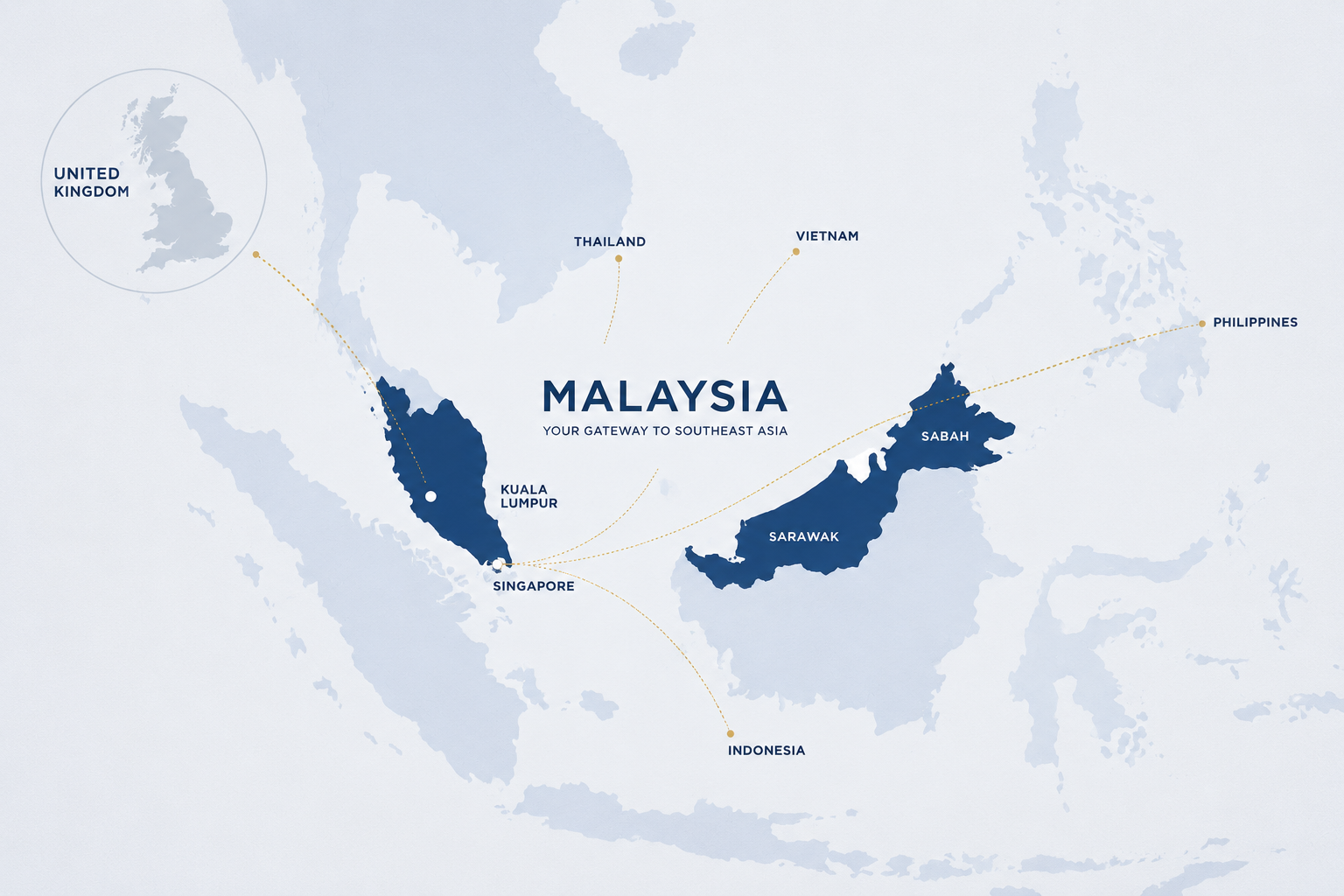
Malaysia is also exceptionally well positioned within Southeast Asia. From Kuala Lumpur, companies can reach Singapore, Indonesia, Thailand, Vietnam and the Philippines within a few hours. This gives businesses access to a regional market of more than 600 million people without requiring every function to be based in its most expensive commercial centre.
Different parts of Malaysia bring different strengths. Kuala Lumpur is a modern and well connected commercial hub. Penang has an established semiconductor, manufacturing and technology ecosystem. Johor is attracting investment in logistics, manufacturing, data centres and cross border services. Sabah and Sarawak bring natural resources, renewable energy potential and growing opportunities in the green economy.
Malaysia therefore offers far more than lower operating costs. Businesses can build substantial teams across technology, engineering, finance, customer operations and shared services while maintaining high professional standards.
Working in recruitment, my view of any market is inevitably influenced by its people. Malaysia has a strong talent base that is still underestimated internationally.
Malaysian professionals often combine good academic foundations, strong English and genuine multilingual ability. Many are accustomed to moving between Malay, Chinese, Indian, Western and wider Asian business cultures. That adaptability is increasingly valuable to international employers and cannot easily be taught.
When I started Kinetik, there was still an assumption in some quarters that Malaysian graduates were held back by education standards or workplace readiness. That has not reflected my experience. The strongest graduates here are bright, practical, digitally capable and highly coachable. They are increasingly confident about the value they can bring to regional and global organisations.
The proposition is not simply that Malaysian talent is cheaper than equivalent talent in Singapore, Australia, Hong Kong or the UK. The real advantage is the quality available at a sustainable cost. That distinction is important because international companies are not merely transferring basic work into Malaysia. Many are building sophisticated regional capabilities here.
The people are also a major reason why I enjoy working in the country. Malaysians are resilient, practical and hospitable, with an excellent sense of humour. Business is relationship driven, but it is commercially grounded. Trust matters, as does the ability to follow through when circumstances become difficult. That suits me because recruitment remains a people business, regardless of how much technology we build around it.
Malaysia’s diversity gives it another advantage. Malay, Chinese and Indian heritage sits alongside the many indigenous cultures of Sabah and Sarawak. It feels unmistakably Asian, but it also has a degree of Western familiarity that makes assimilation relatively easy. It welcomes people from elsewhere without surrendering its own identity.
The country’s appeal extends well beyond business. Malaysia has rainforests, countryside, mountains, islands and beaches, as well as beautiful historic cityscapes such as George Town in Penang. It is possible to leave Kuala Lumpur and find somewhere completely different within a short flight or drive.
East Malaysia adds another dimension. Sabah and Sarawak occupy the Malaysian part of Borneo, one of the most biodiverse places on the planet. The region contains extraordinary rainforests, wildlife, mountains and coastlines, but it is also becoming an important part of Malaysia’s economic future.
Sarawak is developing new opportunities around renewable energy, hydrogen, the bioeconomy and climate technology. The challenge is to pursue that growth responsibly, protecting the region’s environmental importance and ensuring that local communities benefit from development.
This combination of commercial opportunity and quality of life helps Malaysia attract people who want to remain for the long term. It is somewhere you can build a company, raise a family, travel easily and remain connected to the wider world.
Although Malaysia is now home, I do not feel that I have left the UK behind. I travel back regularly and remain closely connected personally and professionally. Remote working allows me to build Kinetik from Malaysia, operate across Asia and still spend meaningful time in Britain. I no longer feel obliged to choose between the two countries because I can keep a foot in both camps.
Malaysia has given me the opportunity to build a business and a life. I came here through work, but I stayed because of the people, the relationships and the sense of possibility. I met Allison, we had Lizzy, and Kinetik grew from a Malaysian base into a regional business.
That personal connection is ultimately why I enjoy working here. Malaysia offers strategic location, strong infrastructure, familiar commercial foundations, excellent people and access to one of the world’s most dynamic regions. More importantly, it has given me family, friendship, opportunity and a genuine sense of home.