A train journey and celebration of Science, Creativity, Innovation and hope..
Article written by Harry Corbett
On 13 April, I arrived at London King’s Cross Station with plenty of time to spare before boarding the 12.14pm Lumo service to Edinburgh.
The first task of the morning was to visit the statue of Sir Nigel Gresley that is situated near the booking office at Kings Cross. Sir Nigel Gresley was the former Chief Mechanical Engineer of the Great Northern Railway and then the London and North Eastern Railway.
He received a knighthood in part for his work on speeding up the railways of Great Britain.
I will expand on this later into this article.
After saluting Sir Nigel it was coffee time and catch up on emails time and where better to go than the Great Northern Hotel, where they have the wonderful GNH Bar.
This is a quiet sanctuary from the Hullabaloo of the station concourse.
Great staff, great coffee, great calm.
I was thinking whilst enjoying this experience that if you were charged with working on the branding and marketing of this bar, it would be easy work due to the quality of the whole experience.
It was soon time to reunite with the Hullabaloo of the station concourse to await the platform for my Lumo train to Edinburgh Waverley.
Standing on the concourse, I was able to admire the great work of Lewis Cubitt, who designed King’s Cross station, including its magnificent roof, as well as the hotel I mentioned earlier, prior to the station’s opening in 1852. Wow, it is superb engineering and architecture.
It is always with a tinge of excitement that I board the Lumo service to Edinburgh.
Lumo is a great ambassador for Open-access rail operators.
The class 803 electric multiple unit looks resplendent in their rich blue livery. The staff are always helpful and work hard to enhance the Lumo brand.
These electric multiple units ( class803) were built in Japan and assembled at Newton Aycliffe so at least the U.K. can in part claim part of the credit for this modern rail success.
At 12.14pm we were away from Kings Cross on time and soon entering Gasworks tunnel ( under the Regents Canal) and soon
after Copenhagen tunnel.
It makes you think about the science and engineering that we experience on journeys such as this one, that have helped to provide hope and opportunity to many people over the last nearly 200 years.
My journey on Lumo was made even better by the help of Salim, a member of the Lumo train team.
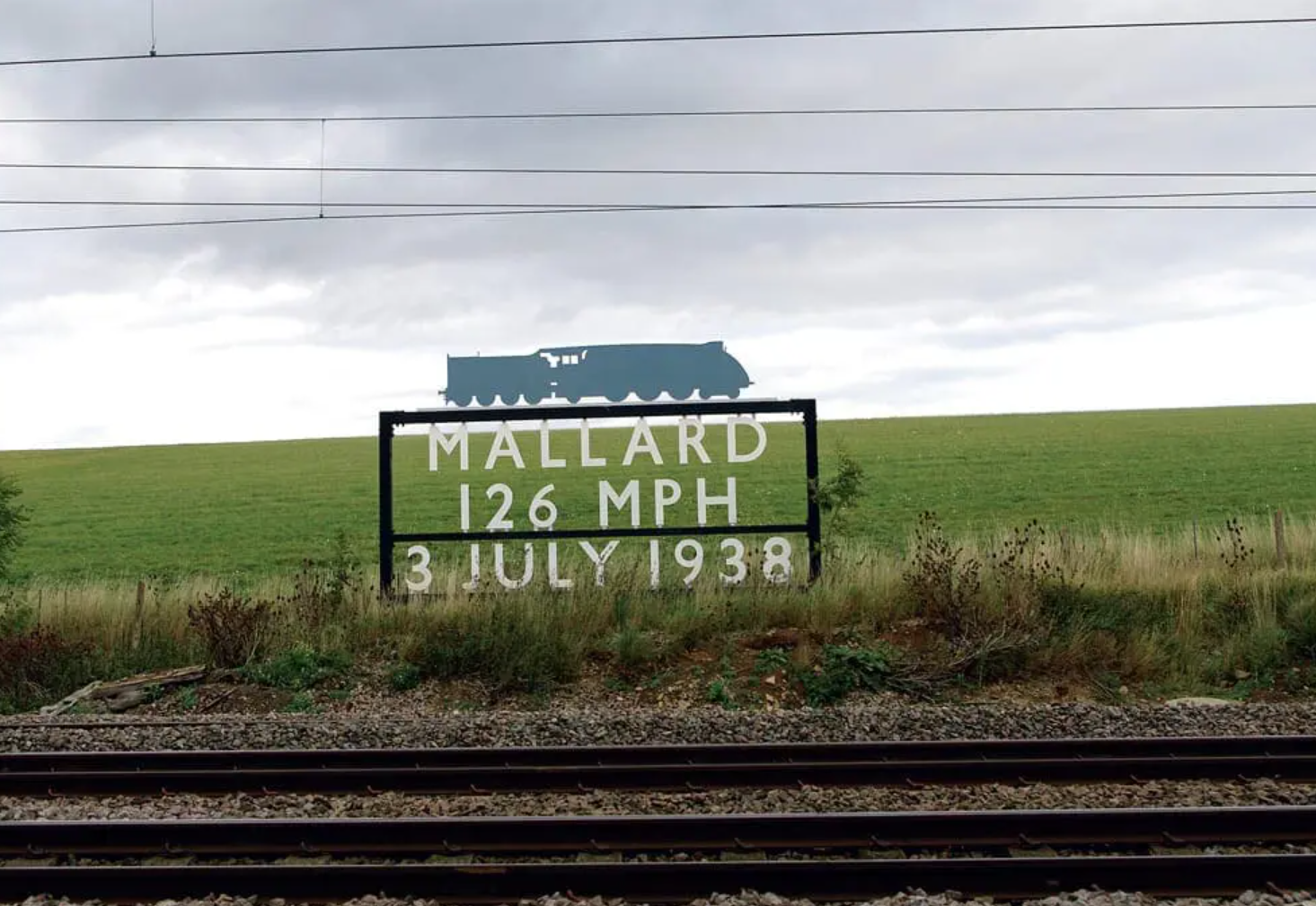
I said I would come back to Sir Nigel Gresley earlier in this short article. So when you leave Peterborough going northwards look to the right of the track and about 11 miles from Peterborough you see a sign that says Mallard 126.
Now this is not a fast duck but actually a fast steam locomotive and one that holds the world record for steam.
Mallard was a class A4 pacific locomotive and one of 35 built at Doncaster ( that great railway City) and it was designed by Sir Nigel Gresley. Like the Lumo train it also sported a vibrant blue livery.
On 3 July 1938, at King’s Cross Station, the Mallard locomotive, not the duck, was prepared to leave with seven coaches, including a dynamometer car, on what was billed as a brake-testing train.
This was in reality an attempt to seize the world record for steam from Germany who at the time had the record of 124.5 mph.
Mallard and its coaches were definitely going to need some brakes on this record attempt, so perhaps it was, in part, a brake-testing train.
After turning the train on the Barkston triangle and heading southwards the footplate team of Joe Duddington (driver), Tom Bray (fireman) and Sid Jenkins ( inspector) managed to achieve 126 mph and therefore the world record for steam between Little Bytham and Essendine. Joe Duddington was a son of Doncaster.
The middle big end bearing of Mallard did overheat in the achievement of this record and so it did have to limp into Peterborough.
The guard of this train was Henry Croucher and in the dynamometer car were Bernard Adkinson and Dennis Carling.
What a team!
So if you just pick up a few points from a journey such as this you soon understand why we have had much to celebrate in Great Britain and indeed still do.
This article is in memory of Mark Levell who was a man that gave brands and businesses a human story and was a great creative talent.