Climate Change As A Form Of Collateral Damage Due To The Kashmir Issue In South Asia
by Zara Hayat, International Relations Correspondent at Intelligence Forums
Introduction:
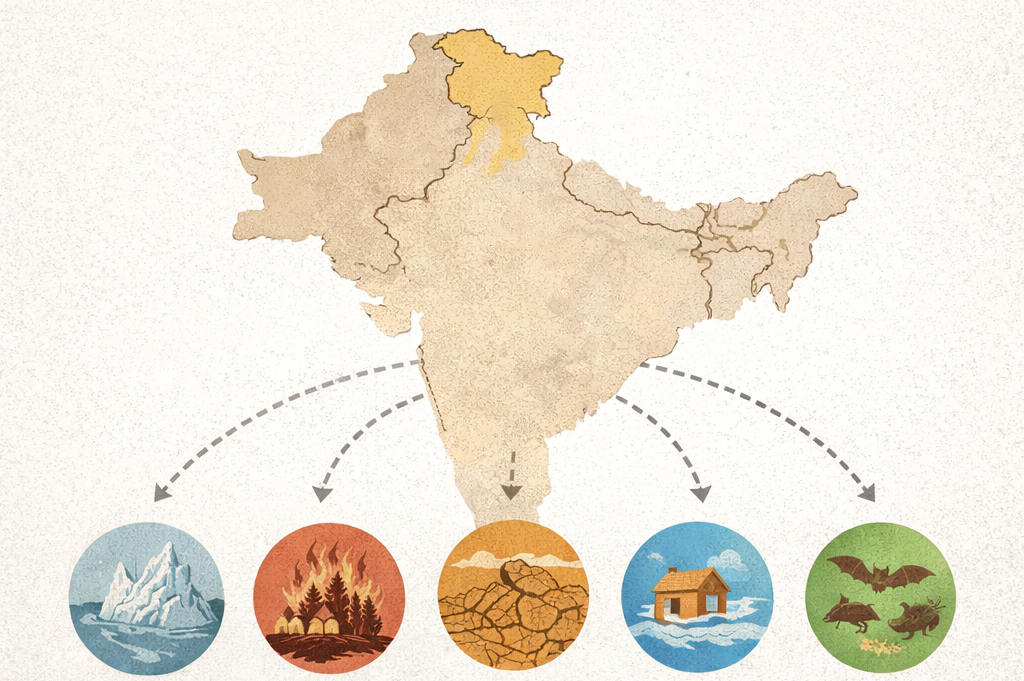
The broad realm of Climate Change is one that has been a very pertinent topic of interest in households, international media and diplomatic forums alike due to the increasingly discernible imprints it has left on ecological stability, human security, and geopolitical fault lines worldwide. Various regions all over the world be it in the core, periphery or semi periphery have been continuing to face unprecedented patternistic events that can be traced back to the effects of climate change. What is increasingly concerning is not just that the effects are inequitable but also deeply entwined with geopolitical conflict dynamics such as the India-Pakistan rivalry over Kashmir. Kashmir is a region that especially stands out due to its unique ecological and geopolitical disposition. The roots can be traced back to the 1947 partition of the subcontinent; now India, Pakistan and Bangladesh respectively. The princely state had a Muslim majority but was ruled under a Hindu ruler and so the long-standing tensions stems from the lack of agreement as to whether this state should be independent or is it rightful part of Pakistan or India respectively. Till present day peace remains a fragile concept in the subcontinent due to these post partition territorial claim dynamics. The crux of this article is not to trace the longstanding and complex discourse between the two nations nor to argue as to which side has the more facile and deserving right of rule but rather to explore how climate change is not a direct weapon of conflict but a strategic consequence amplified by it. The Kashmir conflict, while territorial and geopolitical at its core, has critical implications for environmental stability, climate governance, and human security in South Asia that is being worsened by political insecurity, frozen diplomacy, and militarised landscapes around Kashmir. By highlighting South Asia’s vulnerability to climate change with Kashmir caught in the line of fire, this article explores governance gaps, ecosystem degradation, water insecurity, regional fragmentation, and the complexities of rehumanisation that unfold across the broader region.
The geographic and climatic landscape of Kashmir:
The region of Kashmir emerges through a distinct agglomeration of geographical and ecological systems that are both climatically fragile and geopolitically consequential. Situated between the northwestern parts of Pakistan and India’s Himalayan ranges, it encompasses a holistically diverse and strategically significant climatic landscape. The elongated intermontane valley sits between the Pir Panjal range and the Zanskar range about 3,000–4,000 m above sea level. Other ranges such as the Karakoram support high altitude terrain and glacier systems. Its glaciers that originate in the Karakoram and Himalayan ranges directly feeds into the Indus basin and tributaries sustain major rivers such as the Indus, Jhelum, and Chenab, providing freshwater not only to Kashmir itself but to millions of downstream communities across Pakistan and northern India. Given that the subcontinent is still primarily an agro based economy and some of Kashmir’s own primary exports are dried fruits and vegetables, these transboundary distribution systems contingent on climate remain critical for the greater economy and sociological security. The region is also home to many dense forests contributing timber, fodder, medicinal herbs, and act as a natural buffer for water retention, stabilising river flow and reducing the likelihood of seasonal flooding. Overall the region is known to have a temperate climate, making it an ideal home for many and providing regional jobs, economic growth, tourism and a sense of autonomy for those living in the region. That being said the physiography is under threat due to the fragile ecosystem. With glaciers retreating, snow and precipitation patterns shifting, and hydrology changing, climate change is having an impact on this delicate system, altering ecosystems, livelihoods, and water security in the greater region. These climatic shifts do not just represent normal timely environmental changes but rather highlight the structure of stress on an already delicate ecological system. Accelerating glacial retreats alter the timings of meltwater flows, increasing the risks of short-term flood bursts while undermining long-term water reliability and stability. Concurrently, intensified monsoon variability and changing precipitation patterns disrupt agricultural cycles, strain forest ecosystems, and heighten the frequency of landslides and soil erosion in a region heavily dependent on climate-sensitive livelihoods. This intersection between ecological urgency and persistent militarisation poses the valley as both a climate and security hotspot where environmental stress is magnified by a tug of war between two opposing sides. All these signs suggest that the ripple effects of climate harm are not by chance, but a byproduct of a greater and longstanding conflict architecture prioritising attempts at territorial control and security claims over environmental longevity.
The Kashmir Conflict as a Structural Multiplier of Environmental Risk:
The longstanding conflict has observed many periods of breach of fragile peace in the almost 80 years it has been enacted, acting as accelerants of climate deterioration. The Siachen conflict, often referred to as the highest battleground in the world is one of the perfect examples of a chess piece in global politics between three nuclear countries where ecological damage is treated as an acceptable trade off. The military footprints on glaciers undeniably perpetuates ecological degradation in the already fragile zone that is experiencing glacial retreat and precipitation volatility. In the pursuit of territorial control, both sides have left the glacier with sustained waste accumulation, fuel contamination, and infrastructural disruption even at such extreme altitudes. The aforementioned coupled with the harsh climate is not only a present communal problem but is bound to produce ripple effects of climate catastrophe and ecological degeneration for the years to come. Given that these byproducts are low on the priority list of concern for both countries, this serves as a classic example as to how the Kashmir issue is structural multiplier of environmental risks. Even after the conclusion of the conflict in 2003, the revocation of Article 370 in 2019 by India further widened the governance gaps by centralising authority without corresponding ecological safeguards. Prior to the law’s abolition, the region retained a certain degree of autonomy over its land use, environmental regulation and resource governance which albeit limited, proved beneficial for ecological protection. The post-2019 restructuring stripped not only the people of this autonomy but the land of its protection leaving the land vulnerable to infrastructure expansion and resource exploitation. It is well established that the strategic purposes are the reasons for destruction in soil water and biodiversity. In practice, environmental oversight and climate resilience have remained peripheral considerations, reinforcing a pattern in which ecological costs are absorbed silently as collateral consequences of political consolidation. Another layer of environmental risk emerges through the sociological concerns. The constant societal displacement and nomadic lifestyle as a result of large military presence takes a toll on the region by destroying already fragile economies and ecology is in the process. The restricted livelihoods, and economic precarity reduce local adaptive capacities and environmental empathy, weakening community-based environmental stewardship that might otherwise mitigate ecological decline. Furthermore militarised zones also diminish the potential for environmental prosperity in the future by restricting forward-thinking approaches such as environmental monitoring and climate research and education through the disproportionate allocation of resources and long-term investments towards conflict mitigation. The greater climatic and ecological repercussions of this long-standing conflict also extend into heightened zoonotic risks. In an area where climate sustainability is already weak and limited, habitat disruption, biodiversity loss, and disrupted human-wildlife interactions exacerbated by deforestation, military incursion, and climate-driven ecosystem alterations raise the risk of disease transmission. These hazards are not coincidental; rather inherently generated by the intersection of militarisation, government fragmentation, and environmental deterioration. Altogether, these intersected variables prove that climate change in this region is neither an isolated variable nor an entirely natural phenomenon. The strategic drivers of environmental risks create a cyclical problem where the need to prove regional authority is at the cost of environmental protection and prosperity.
The Indus System weaponisation - Water Scarcity, Geopolitics, and Treaty Strains:
The Indus River system is not only one of the most complex and strategic transboundary systems, but it is absolutely critical for the functioning and prosperity of ecology and greater geopolitics. Known as the water tower of South Asia, the 3,180 km long transboundary river in Asia originates in Tibet and then passes through the northern part of India and Kashmir before flowing primarily through Pakistan down to the Arabian Sea. With a drainage basin of over 1.1 million km², it’s known to be an integral resource for agriculture, hydropower, and local economies particularly in Pakistan. The Pakistani system includes six major rivers; the Indus, Jhelum, Chenab, Ravi, Beas, and Sutlej. For Pakistan’s economic security the Indus water system is especially vital as 80% of its arable land relies on these rivers for functioning. That being said, the river does not just serve as an economic artery. It constitutes some of the most ecologically distinctive freshwater systems in the region supporting diverse and often fragile ecosystems, including wetlands, floodplains, and riverine forests that host numerous species, not limited to the endangered Indus River dolphin. Factors such as pollution, infrastructure expansion, habitat fragmentation, and accelerating glacial melt threaten these valuable terrains, placing unprecedented strain on this ecological corridor. What was once a reliable hydrological system is being increasingly weaponised in the pursuit of territorial sovereignty. It is for these reasons that in 1960, the World Bank mediated the Indus Water Treaty. In attempts to compartmentalise transboundary forms of nature, the three eastern Rivers Ravi, Beas, Sutlej were allocated to India and Indus, Jhelum and Chenab to Pakistan. Whilst a success on paper as the treaty has been regarded as one of the most durable water-sharing agreements globally observed, with time cracks in the treaty have emerged due to constant regional tug of war. What used to be a buffer mechanism is increasingly tested and weaponised when climate contingent tensions ebb and flow. Rapidly increasing glacial retreats and intensified monsoon variability are altering seasonal river flows, encouraging both flood surges and drought risks simultaneously. These hydrological shifts further complicate infrastructure planning, reservoir management, and diplomatic relations as historically agreed baselines become less reliable under altering climatic conditions. Technical disagreements over hydropower projects and storage capacity increasingly acquire political salience in an already distrustful and blaming environments and are often used as leverage for political gain. A recent example would be in April 2025 when India announced that it was suspending the six decade-long agreement following a militant attack in Indian administered Kashmir, despite the perpetrator’s nationality never being determined signalling how water governance itself can bear the collateral brunt of geopolitical confrontation. Climate variability adds to the precarity of the dynamic. Melting glaciers and increasingly unpredictable monsoon patterns are reshaping river flows, creating profound trans-border disruptions across societies, economic stability, and biodiversity. Concurrently these environmental transformations leave room for new avenues for diplomacy within the subcontinent that in principle could serve as constructive platforms for peacebuilding but given the tumultuous historical relationship between Pakistan and India, such opportunities often prove lost and counterproductive. Instead of alleviating tensions for the greater good, unresolved disputes compound in the form of emerging environmental pressures, causing stresses to accumulate rather than diminish. Rather than serving as the ideal platform for cooperative climate preservation and prosperity, the Indus increasingly reflects the collateral damage greater South Asia faces due to the mistrust embedded within the Kashmir dispute.
A shared climate tragedy – the cost of division/regional fragmentation and governance gaps:
It should be noted that there is substantial discourse out there suggesting that whilst climate tragedy is a shared experience, the two countries that have been perpetually conflicted over this region are comparatively the states that bear the least brunt. It is the people and terrain of the disputed territories that do so. Kashmiris in both administered regions experience the effects of the conflict as twofold where environmental stressors compound on already fragile governance and restricted mobility. With a rise in extreme weather events such as inequitable distribution of droughts, flash floods, erratic snowfall, and landslides; the region is not only struck with extreme chronic securitisation but limited adaptive capacity in the process. Frameworks for climate resilience, early warning systems, sustainable land management, and watershed protection are all inconsistently implemented and tend to be divided along political lines due to the lack of strong, collaborative transboundary institutions. Instead of being integral in this situation, environmental care becomes optional. With no end nor renumeration in sight, decades of militarisation and political uncertainty have produced governance gaps that extend beyond diplomacy into environmental preservation and care. Long term climate restoration, conservation and education remain intentionally deprioritised by both governments in a region where security imperatives dominate administrative attention. The consequences left for the collateral third party to bear. That being said even the states in question are facing continuous crisis due to the ongoing conflict signalling how in this perpetual egotistic tug of war nobody really wins. Pakistan often records devastating floods every few years such as those most recently in 2010, 2022 and 2025. Millions were displaced, agricultural land was submerged, and public health systems were stretched to breaking point .These tragedies as well as the spillover effects can be clearly linked to climate factors exacerbated by political tensions over shared waters, intense monsoons & diminishing forests. Circumstances on the other side of the border look very similar. In India, destabilising climate shocks have manifested through intense monsoon flooding in Himachal Pradesh in 2023 and recurrent subsidence and landslide crises in Uttarakhand, both Himalayan regions deeply affected by infrastructure expansion and environmental stress, revealing ecological fragility in the broader Himalayan-Kashmir system reverberates across borders. On both sides, these displacements and loss of lives affect the agrarian communities and those in the suburbs almost unilaterally, linking environmental degradation directly to human security. Coupled with the lack of concrete cross-border security driven relief policies, even in moments of shared environmental crisis humanitarian response mechanisms can be constrained by surveillance regimes, restricted mobility, and diplomatic mistrust. The result is a fragmented regional landscape in which climate change functions as a shared root cause of suffering, yet political division inhibits collective mitigation practices.
Climate change as collateral damage - The Larger Geopolitics:
Building on the larger geopolitics of climate change as a form of collateral damage, the degradation of the third pole serves as a classic example. Encompassing vast glacial reserves that sustain major Asian river basins including the Indus, Ganges, and Brahmaputra, degradation cannot be understood as purely environmental decline. It reflects the broader geopolitics of climate change, where environmental systems absorb the externalities of unresolved territorial disputes and militarised borders. Here the ecosystem becomes an inadvertent casualty of political fragmentation, with consequences transcending across downstream communities and future generations. Chronic transboundary tensions are continuously heightened as climate change becomes a security amplifier through intensified grievances, resource competition, and the vulnerability of broader populations comes under scrutiny. Whilst in theory this should be an adequate enough reason for regional cooperation even on other issues, in reality cooperation proves to be increasingly difficult due to the persistent entrenched mistrust and blame game serving both personal and collateral loss. Periods of heightened diplomatic strain following security incidents have demonstrated how even humanitarian or environmental coordination can be put aside in light of strategic calculations. The persistence of zero-sum thinking exacerbates the institutionalisation of climate diplomacy, reinforcing fragmentation rather than resilience. This operationalisation is closely in line with the environmental security theory. The theory reframes climate change not solely as an environmental issue but as a national security concern. In South Asia, climate discourse is increasingly embedded within defence and strategic planning frameworks, where water scarcity, disaster instability, and cross-border migration are treated as potential security threats. Whilst looking at these issues from the lens of a security threat can elevate their priority status, it risks narrowing the lens through which solutions are pursued and value is placed. When climate is viewed primarily through the lens of sovereignty and strategic competition, cooperative adaptation, long-term diplomacy and environmental care become secondary to national self-preservation and reputation. In many ways this reflects a regional manifestation of what can be described as the American Paradox. The compartmentalisation of national self interest from global responsibility despite their growing inseparability. In the context of the third pole for example, the pursuit of strategic dominance or territorial assertion is often detached from ecological consequence in political discourse. Nonetheless environmental consequences of fragmentation do not respect the abstract boundaries created by societies. Climate change therefore emerges not only as a shared tragedy, but as a structural by product of geopolitical rivalry, a collateral damage of division that ultimately undermines the very security it strives to protect.
Complexities of rehumanisation in a Climate-Conflict Nexus:
Whilst Kashmir may ebb and flow from the focus of the world's political attention, the various complexities present in rehumanising the people and the region remain unchanged. The region is primarily treated as strategy rather than valorised. Rehumanisation refers to the restoration of human dignity and autonomy through the dissemination of equitable value and care. It stems from the idea that your worth and dignity is the result of factors and circumstances beyond your control. In the case of those stuck in the climate-conflict nexus, it would require the urgent recognition of how communities across both Indian and Pakistani administered Kashmir disproportionately bear the compounded burdens of glacial retreat, recurrent flooding, and livelihood disruption while possessing limited agency over the political decisions that shape their environment. Only once the gravity of the situation has been registered can appropriate steps towards rehumanisation then be taken. In Kashmir the overarching ideas of loss, generational trauma and unwavering resilience are not just passed on through individuals or the larger society but through the environment as well which is why it is imperative to not only to recognise that rehumanisation comes in many forms but the interconnectedness aspect of it. The rebuilding therefore must operate as a multifaceted approach. Agrarian communities prove how it is within fragility that lies resilience. Adapting to shifting growing seasons, families rebuilding after successive climate disasters, and local actors continuing to steward fragile ecosystems and educational practices despite limited institutional support. It is the act of giving adequate heed to this resilience without romanticising the suffering that is essential to restoring dignity without perpetuating narratives of victimhood. After all, at its core climate adaptation and peace-building is a human-centric challenge rather than a purely state centric one. Environmental degradation directly affects food security, public health, education continuity, and mobility, blurring the lines between climate vulnerability and human rights. When glacial retreat alters river flows or extreme weather destroys homes, the consequences are borne not by abstract political entities, but by individuals navigating disrupted lives. Rehumanisation would require policy frameworks that not only understand the complexities that arise with such circumstances but those that prioritise human security/rights. This then begs the question as to how can we move forward with more emotional cognisance and what are the potential ripple effects of that. Questions arise as to how can those who hold whatever degrees of power move with empathy and in a way that does not make the affected seem subpar but give them their dignity/autonomy back with grace. Moving forward with empathy does not imply weakening sovereignty, but recognising shared vulnerability as environmental harm blurs the artificial lines of the conflict and climate impacts don’t discriminate. Rehumanisation therefore necessitates reframing climate change not merely as an environmental or geopolitical variable, but as a living reality that affects food security, health, education, mobility, and dignity valorising populations whose environmental suffering has become normalised within disputed territories. Such people must be recognised as central stakeholders in climate and peace processes. Such processes actually have potential to break the broadened cycle of poverty and climate vulnerability in which regions disproportionately exposed to climate harm are structurally more likely to remain trapped within it across generations. Ultimately rehumanisation would entail human security and dignity to take precedence over national security. Additionally if progress is made in this respect the likelihood that the two countries could work together to solve other issues on a local and international sphere also increases.
Conclusion:
In summary, Kashmir serves as the epitome of a zero-sum security paradigm. The intractable climate crisis unfolding across South Asia cannot be understood in isolation from the political history and systems it is entrenched in. Rooted in the unresolved legacies of the 1947 partition of the subcontinent, the region has long been framed through competing claims of sovereignty and territorial legitimacy at the expense of the greater environment, producing parallel casualties such environmental stability itself. Climate change in this context emerges not as an external shock but as form of collateral damage intensified by militarisation, paralysed diplomacy, and the prioritisation of strategic dominance over ecological and human security. As glaciers recede, rivers grow unpredictable, and communities across Kashmir and the wider Indus Basin consistently bear the costs of decisions made on their behalf, the limits of a purely state-centric security paradigm become increasingly evident. Complexities of rehuamnisation add further layers to the climate–conflict nexus. It does not require the erasure of borders, rather a revaluation of what security and humanity means in an era defined by planetary vulnerability. Without cooperation rooted in trust, empathy, shared responsibility, and environmental foresight, the region risks allowing a longstanding unresolved political dispute to dictate its climatic future at rapid rates. Existing regional and international frameworks from water-sharing mechanisms to climate adaptation governance are largely designed from a political lens which is why environmental stress has been peripheral rather than structurally embedded within conflict. As climate impacts increasingly intersect with questions of reputation, stability, displacement, and resource access, their continued separation from peace and security architectures represents not only a moral oversight, but a strategic one. In a landscape where nature itself refuses to conform to lines of control, sustainable peace and climate resilience may ultimately prove inseparable not as ideals, but as urgent necessities. Ultimately Kashmir’s autonomy must be set as the absolute pinnacle point to be able to collectively push past this ramification.
Ending statement:
This article was written in February of 2026 and therefore does not take into account anything that happened after this time. It has tried to be as objective and impartial as possible yet it is possible that opinions and sentiments may have seeped in. Additionally whilst it is not all encompassing of all ways climate change is a form of collateral damage in South Asia, it has tried to highlight some of the most pertinent ones.