Justice in Climate Representation
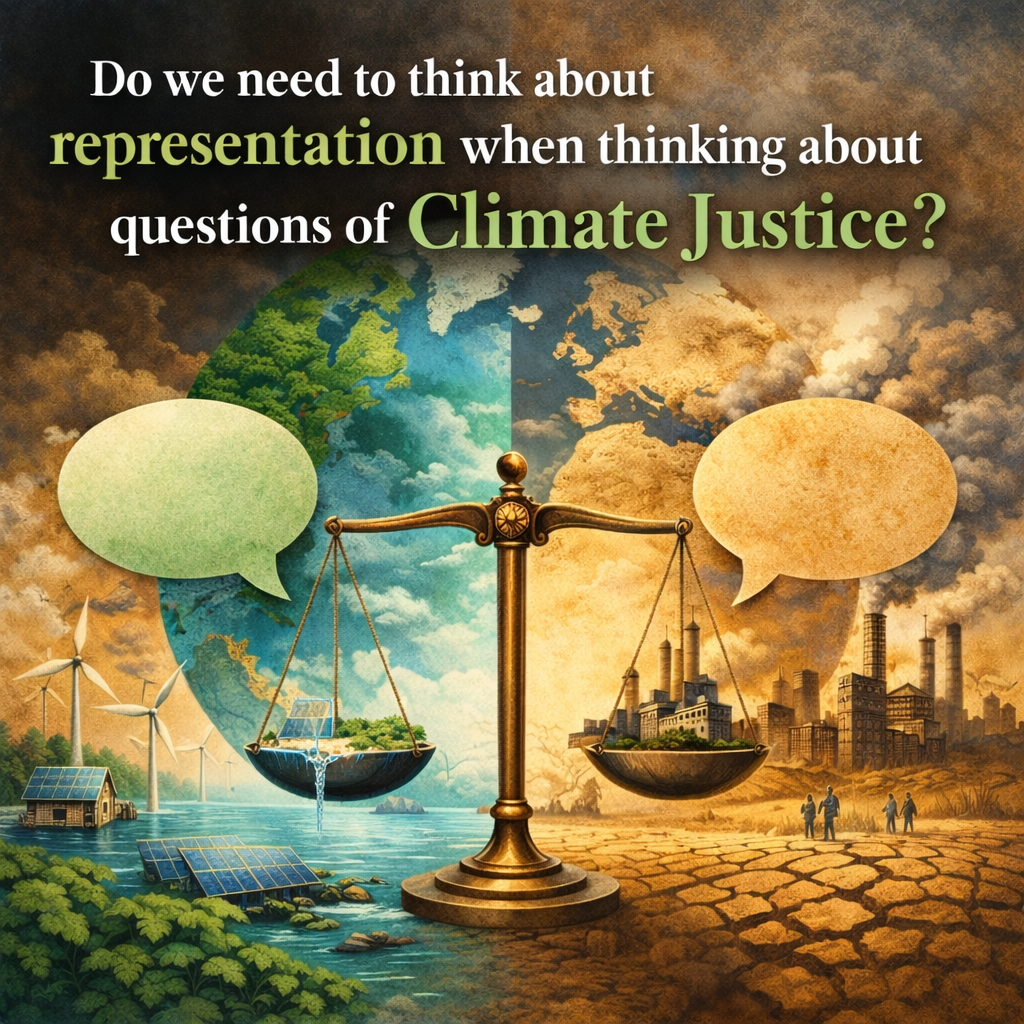
Do we need to think about representation when thinking about questions of Climate Justice?
by Zara Hayat, International Relations Correspondent at Intelligence Forums
In the recent years there has been a surge in conversations regarding climate change and therefore climate justice due to its growing pertinence. Stemming from that would be the idea of climate justice both as a moral and as a political imperative in the face of accelerating environmental collapse. While the questions are often framed around emissions and adaptations, the more profound questions would be what the shared meaning of justice is, who decides that and whose voices shape it's pursuit. Equitable representation of people and their regions become a crux of climate justice. We must give adequate heed to representation when thinking about climate justice, because the climate crisis is not only environmental but deeply social and political, embedded in legacies of colonialism, exclusion, and structural inequality. Farhana Sultana’s (2022) framing of critical climate justice and Wilkens and Datchoua-Tirvaudey’s (2022) critique of the “coloniality of climate knowledge,” emerge as key anchors, defining climate justice and representation by drawing on postcolonial theory and the concept of rehumanisation as a guiding themes to examine the cases of Tuvalu and Pakistan, illustrating the stakes of misrepresentation before concluding that without inclusive, accurate and meaningful representation, climate justice risks paradoxically reproducing the very injustices it claims to oppose.
Climate justice, a term gaining popularity in mainstream policy discourse, remains a contested and evolving concept. At its core it sheds light on the fact that those least responsible for climate change whether it be the vulnerable countries in the global south, indigenous communities or low income populations are often the ones paying the most consequences. Yet beyond this distributive framing lies a more radical critique. Farhana Sultana (2022) asserts that climate justice is not only about outcomes, rather also about the structural processes that produce and reproduce vulnerability. This stance shifts the conversation from solely compensation to broader ideas of visibility, voice, and historical accountability. Drawing from postcolonial theory we can view climate justice as embedded in the ‘coloniality of power’ (Quijano, 2000 ; Wilkens et al. 2022). This refers to the persistence of colonial logic and dominance in modern global structures. The term can be broadened to describe the coloniality of climate knowledge, another form of western technocratic domination where alternative ontologies such as indigenous relational understandings of land and ecology are suppressed or dismissed entirely. This epistemic injustice has material consequences as policies that ignore local knowledge prove a lack of respect for the land and the people that bestow it but they also often fail and end up causing harm in already vulnerable contexts (ibid.).
Representation is woven into climate justice through both procedural inclusion and discursive construction, both shaped by power. Procedural inclusion refers to who is present in climate governance and policies whereas discursive construction highlights whose knowledge, identity and most importantly humanity is recognised. In international negotiations like the UNFCCC, for instance, state actors especially first world ones dominate while frontline communities and non-Western epistemologies are often marginalized or tokenized (Wilkens and Datchoua-Tirvaudey, 2022). This is why representation is not just about being present but more importantly about being heard, respected and valued enough to have the power to shape meaningful change. This shift will need to involve interlinking ideas of rehuamnisation and reframing. As Farbotko and Lazrus (2012) proved in their study of Tuvalu, climate discourse often casts islanders as passive refugees not only stripping them of their agency but rather also their dignity and worth to an extent reinforcing paternalistic tropes. Nixon (2011) deems such portrayals as a form of slow and passive violence, as it slowly erodes the dignity of the affected population under the guise of humanitarian concern and aid. In contrast, rehumanising climate affected communities means reaffirming their right to narrate their own futures, resist victimhood, and participate as political subjects further solidifying the need for representation in climate justice. To think about climate justice without thinking about representation is to ignore the conditions under which justice itself is constructed as representation is a condition of justice not its outcome.
Postcolonial theory exposes how the current global climate regime continues to be structured by historical hierarchies of power, race, and knowledge. Chakrabarty (2009) & Mignolo (2009) argue that the legacies of the empire have not been erased from international governance with time but are ingrained in the epistemology instead. When speaking of climate justice this comes in the form of both material inequalities as well as symbolic erasures especially in the global south that is known to be disproportionately vulnerable and affected by the ripple effects of climate change and a lack of justice. It is often denied the epistemic and political agency to define what justice means in its own context. A prime example of this would be Pakistan. In 2024, the Food and Agriculture Organization of the UN (FAO) reported Pakistan amongst the top ten countries most affected by climate change despite producing some of the lowest emissions. The 2022 floods, which submerged a third of the country and displaced over 33 million people is testament to that yet the international response, or lack of was telling. The response from those still at the top of the hierarchy was slow, technocratic, and embedded in a donor-recipient stance that mirrored colonial paternalism. Adding layers to the complexities of rehumanisation, the western media hyper fixated on imagery of suffering furthering the subhuman sentiment whilst Pakistani scientists, policymakers, and activists were largely absent from global platforms. From a postcolonial perspective, such dynamics are not incidental but structural. As Tirvaudey (2022) notes, the “coloniality of climate knowledge” positions Northern technical expertise as neutral and universal, while reiterating the stance that Southern or indigenous knowledge is anecdotal, emotional, or irrelevant. In Pakistan, this plays out in the marginalisation of rural communities from national adaptation planning. These communities are often constructed as vulnerable populations to be managed, rather than active political agents with geographical knowledge of resilience hence their omission from climate decision making processes, even though it is their livelihoods that is directly shaped by environmental volatility. This epistemic injustice tends to be reinforced by institutional structures. International climate finance mechanisms, such as the Green Climate Fund, require grant proposals that conform to Western scientific framings and English documentation only. Whilst one may argue that this is to create an element of universality, it creates barriers for local actors in Pakistan to access funding, despite their on ground legitimacy. Due to this, representation is not only symbolic it has material consequences. Communities excluded from defining problems are also excluded from resourcing their solutions. Postcolonial critique thus helps recognize that climate justice is not simply a matter of reallocating carbon budgets or funding adaptation rather it requires confronting the deep rooted asymmetries that shape whose suffering is acknowledged, whose expertise is legitimized, and whose futures are imagined by reevaluating the value we collectively put on representation. Pakistan’s example exemplifies how climate vulnerability is not a natural state but a politically borne one, arising from centuries of extractive development, state/community marginalisation, and global neglect. The epistemic silencing directly highlights why representation is critical in climate justice.
To move toward climate justice, representation must be rethought of with the lens of rehumanisation, not as a performative token of inclusion, but as the equitable redistribution of epistemic and political power. This means supporting indigenous governance mechanisms, prioritizing grassroots voices in adaptation planning, and ensuring that affected populations can shape the narratives that circulate about them.
When thinking about representation it is not only important to give heed to the inclusivity aspect but also to be cognisant of misrepresentation as a form of injustice. The way the communities affected by climate catastrophe are portrayed by states, media and international institutions has real-world consequences for their political agency, cultural continuity, and survival in the form of obscuring agency, eroding dignity and legitimising paternalistic interventions (Sultana, 2018). Tuvalu, a low-lying Pacific Island nation frequently cited as a symbol of existential climate threat can be used as a prime example for this as it is often portrayed as a sinking island and a source of future climate refugees. These narratives, whilst raise awareness, simultaneously flatten the complexity of Tuvaluan identity and political resistance. Nixon (2011) would argue that this ongoing dehumanisation through misrepresentation is a form of slow violence with indications of a colonial gaze where the global south is cast as tragic voiceless and passive. This misrecognition has substantial stakes. Firstly it frames Tuvaluans as mere victims facing consequences of the actions of others rather than political and knowledgeable actors demanding reparative justice and adaptation support on their own terms. Sultana (2022) contends that reducing communities to symbols of suffering carries the possibility of "epistemic erasure," in which Northern imaginations take precedence over local knowledge, spiritual understandings of the land, and claims to sovereignty. Enele Sopoaga, the country's former prime minister, consistently opposed the misrepresentation that Tuvaluans will inevitably migrate out of northern force, highlighting instead their right to stay and their demand for global accountability and reductions in emissions (McNamara and Farbotko, 2017). These claims, which promote climate agency and refute the narrative of helplessness, are frequently disregarded in prevailing discourses. Secondly discursive misrepresentation has the power to shape material outcomes. Given the lack of political agency and the dismissal of local knowledge, climate funding and relocation policies are more likely to be designed for Tuvaluans than with them framing the north to once again be the all knowledgeable saving grace and adding another layer to the complexity of rehumanisation. The misrepresentation of Tuvalu as constantly vulnerable and at the mercy of a higher power enables technocratic solutions such as diaspora planning or cultural archiving, often without substantive community consent echoing Wilkens and Tirvaudey (2022) idea of the coloniality of climate knowledge where northern institutions assume authority to define problems and prescribe interventions, while Southern communities are treated as recipients of pre-designed responses without their own inclusion. Lastly the misrepresentation of Tuvalu as a symbolic face of planetary loss risks instrumentalising Tuvaluan suffering for global climate negotiations. The moral language of climate justice is frequently used by strong players alone to gain credibility or negotiate concessions, while the voices of those summoned are marginalised. (Skillington, 2015). When discursive inclusion is used as a cover for persistent procedural exclusion, this often has long-term and complex consequences that the misrepresented bear the brunt of. All this proves how misrepresentation can be strategically weaponised and used as a form of injustice further reiterating the stance that adequete and fair representation is crucial when thinking about climate justice so that Tuvaluans people can be authors of their own narratives rather than portrayed as helpless recipients.
In summary, to think about and act on climate justice without thinking about equitable representation is not only counterproductive but obstructs the very foundations upon which justice must sit. Through examining both procedural and discursive dimensions of representation, it has highlighted how power asymmetries rooted in colonial legacies and sustained by contemporary global hierarchies continue to shape who is seen, who is heard, and who is silenced in the climate arena. Drawing on postcolonial theory and highlighting the complexities of rehumanisation through cases of Pakistan and Tuvalu we can illustrate that representation is not merely symbolic, but a material condition of justice, shaping both the allocation of resources and the configuration of political agency. These case studies highlight the existential as well as political and cultural stakes of representation as deep-seated in global power structures. As depicted, misrepresentation may weaken resistance, justify slow violence, and perpetuate the very inequities that climate justice aims to address creating a cycle of oppression that can only be rectified through a thorough and communal understanding of the importance of representation in climate justice to begin with. Moving forward climate justice must shift from beyond conceptual and performative inclusion to a radical reconfiguration of participation, education and authority. This requires dismantling the epistemic hierarchies that privilege Western technocratic knowledge, while amplifying indigenous, feminist, and Global South voices and their value in all spheres of global climate governance. Climate finance mechanisms must be restructured to be accessible, accountable, and locally anchored. Most notably, narratives of crisis must be reframed to centre not only vulnerability, but dignity, resilience, and sovereignty to aid in the complex rehumanising of those affected by climate change.