Reflections on 40 Years of Railway Preservation in East Kent, Plus a Bit of Bus Preservation - Part II
Article written by David Harris, Chairman of the Trustees, East Kent Railway Trust
My first article for this written forum told of the very early days of the preservation project to save the EKR.
Moving on to the first trains we ran on the EKR: these were two Diesel Multiple Units – a Network SouthEast class 108 and a ScotRail class 107. These belonged to a member of the preservation society. He later sold them, but plenty of experience was gained in operating them, and operating the railway in general – by this time we had a lease for the entire branch line. In addition, a group on the railway had custody of an ex British Coal diesel shunter, a John Fowler. This came from a local colliery. NCB (British Coal) had purchased it from the Port of London Authority, and they retained title to it.
Let us now return to those very early days. As I said in Part 1, the BR Property Board only leased us land initially to Shepherdswell Station throat. We the Trustees were very concerned about the whole of the track bed to Tilmanstone Colliery being sold off, as this would destroy all of our plans to run trains. At this time only the John Fowler was on site. All the track was in situ and in good condition. This was the time of BR Sectorisation - the track on this colliery branch line was owned by BR Freight sector.
We formed a limited company and sold shares to Society members. This was initially to have ‘our’ land fenced off from BR land including BR woodland. We negotiated with BR Freight sector to purchase all the track (rails, sleepers, points etc) to the colliery rail entrance, except the section which was part of the Shepherdswell lease. Eventually, after negotiations, a price was agreed and we purchased this section of track. The idea was that BR would find it difficult to sell land that had a company’s railway on it. We the company directors loaned money to the company to facilitate this purchase.
We also purchased an 0-6-0 diesel shunter for the company. This was an English Electric with a Dorman engine. As we only had the Shepherdswell station site, we stored this loco near Richborough in East Kent. Richborough was the Roman gateway to Britain, and the Romans built a substantial fort there. This is called Richborough Castle and is an English Heritage visitor attraction. We named the loco Richborough Castle and had name plates made (stamped not cast though).
When the land lease was renewed it was for all the line, and BR transferred the Light Railway Order to us. The EKR is a genuine Light Railway under the Acts of 1896 and 1912. The English Electric 0-6-0 was used on works trains as full line vegetation clearance and new fencing work was carried out.
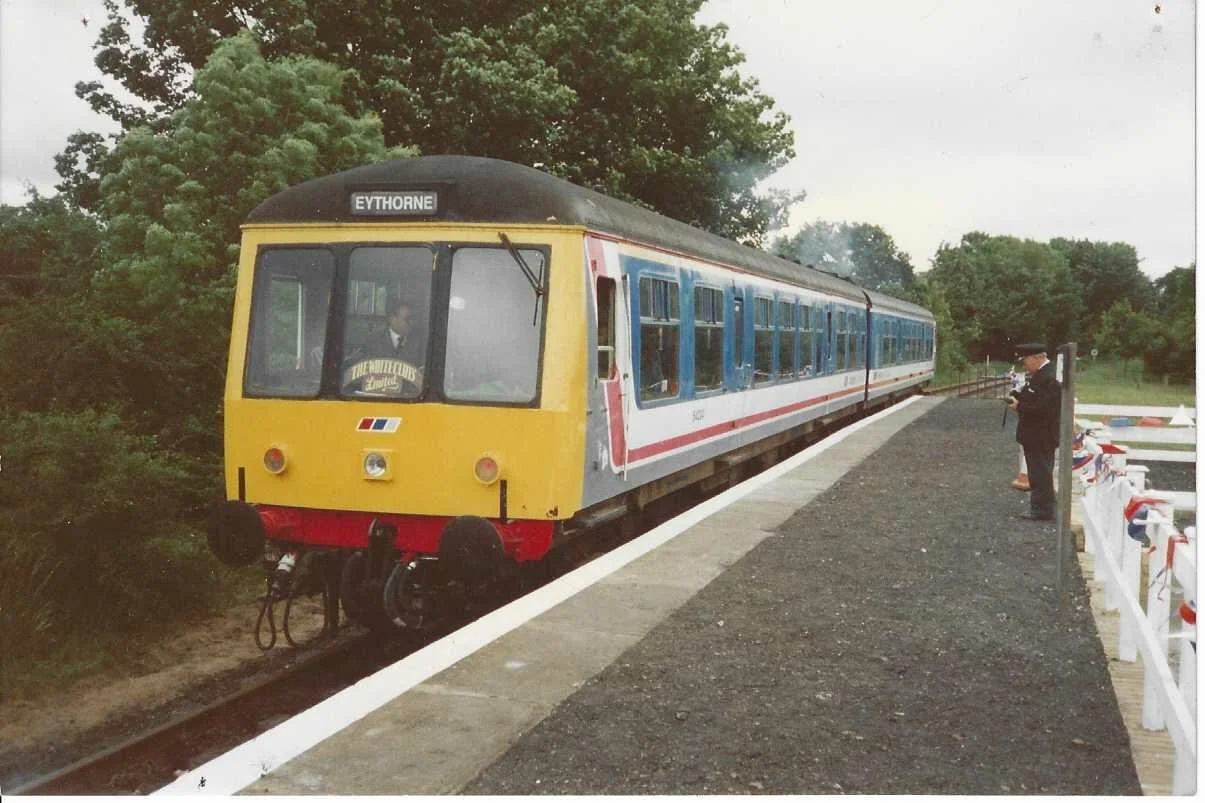
Services started with the DMUs; most used was the class 108 (pictured). Parents brought children along and we train crew were told frequently, “It’s the first time he’s been on a train.” Later, when I joined the world of heritage bus preservation I heard similar comments, such as, “We don’t use buses.” However, the world is changing and public transport will have to be the norm! Electric traction for trains and battery electric traction for buses – will we ever see trolley buses again?
A few years later we were in a position to purchase the freehold of the land and the remaining trackwork which was in our first piece of leased land. BR Property Board did not like our unincorporated status, and also suggested that the new organisation we were about to set up would need a Transport & Works Act Order. We sought help from the Heritage Railway Association for this.
A ‘Limited by Guarantee’ company was formed and charitable status obtained for it. (Our original society had charitable status). Eventually the TWAO was obtained. The new company took over all the assets and liabilities of the society which was then wound up, and we obtained title to the land.
However, not all the land owned by BR Property Board was in the sale at the time. A large area of woodland was retained by BR plus three brick buildings. These were two shell stores erected in WW2, and a post war building. Also, at Eythorne village the track bed passed through a larger area of land. This is owned by Dover District Council. As the land was absolutely essential to our operation a 99-year lease was granted. The first task here was to obtain a ‘Footpath Movement Order’. This was acquired and a fenced footpath was created further up the site, including a boarded crossing and steps down to the adjoining fields each side.
There is much to creating a heritage railway. I will return to the woodland at Shepherdswell in a future article.